
About this chapter
Every project has a point where it stops being an idea and starts becoming a practice.
For me, this chapter marks that moment.
While writing Executive Functioning Is a Team Sport, I began to recognize that the questions I was asking about parenting, neurodivergence, queerness, expressive arts, and belonging were all leading toward the same place. They were asking what becomes possible when we create environments where people no longer have to perform belonging before they can participate.
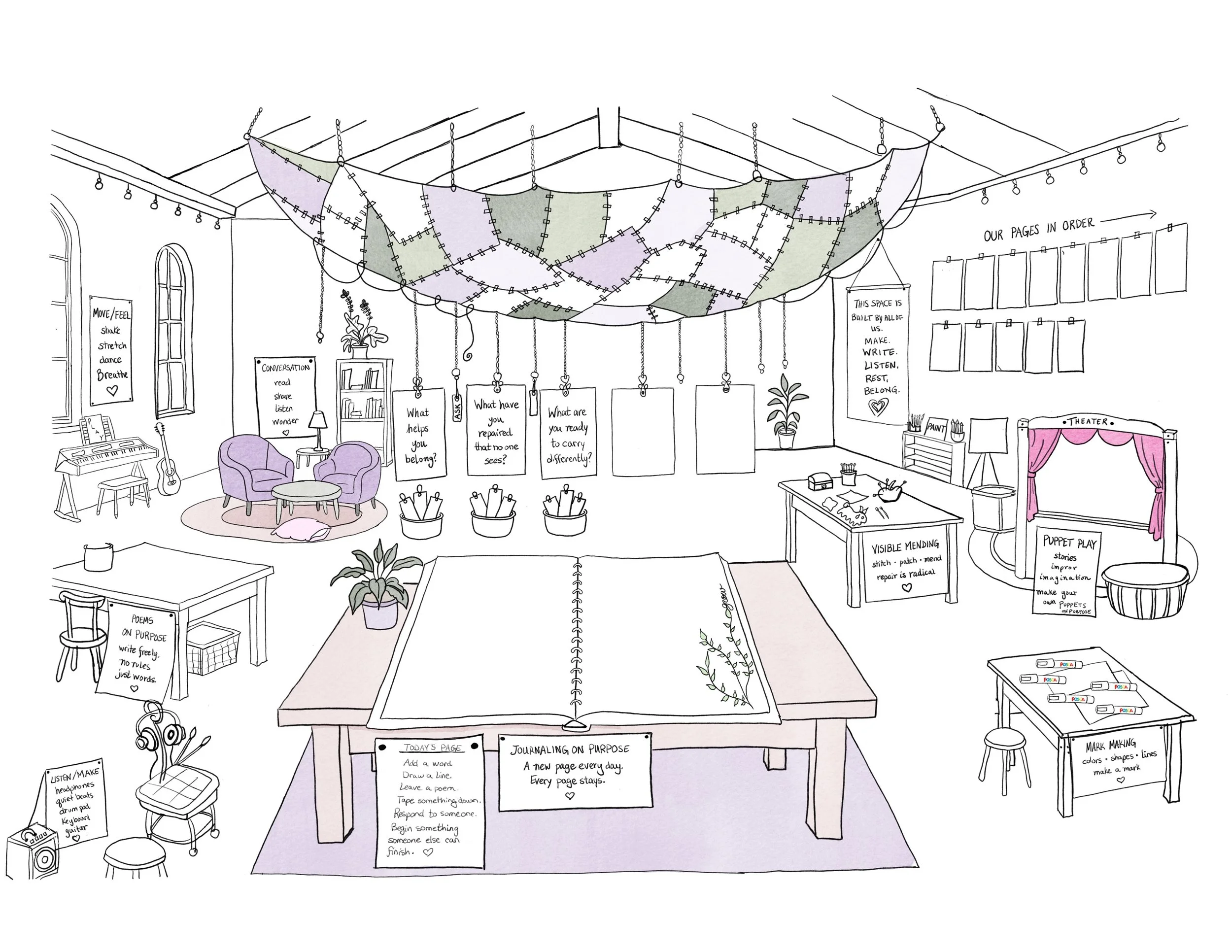
The residency proposal, Variations on Belonging: A Creative Playground, is a continuation of those questions. It imagines a community art studio where belonging is explored through making, movement, conversation, music, writing, and play.
I am sharing this chapter because it offers the philosophical and creative context from which that work emerged.
Different On Purpose
There is a particular kind of exhaustion that comes from being deeply perceptive in a world that keeps insisting you are misunderstanding it. I spent most of my life assuming this exhaustion was a personal failure. Maybe I was too sensitive, too intense, too emotional, too much.
I was hyperaware of systems and people and the strange invisible emotional weather moving through rooms that everyone else seemed willing to ignore. I could feel tension before words happened. I could watch entire family systems organize themselves around avoidance while everyone sat in a kitchen pretending to discuss dinner.
Meanwhile, I was over there accidentally absorbing the psychic radiation like an emotionally uninsured civilian. This skill turns out to be moderately useful as a therapist. Less useful when attempting to exist as a single mom inside capitalism.
For years I believed the solution was better masking, which basically means performing professionalism with emotional regulation, organization, and better hair. Definitely better hair.
I thought adulthood would eventually arrive like a software update. One day I would wake up wanting to meal prep and answer emails in a reasonable amount of time. Instead I became increasingly aware that most of my energy was being spent trying to appear neurologically compatible with environments that were actively injuring me. The kind of pain that leaks in slowly like emotional carbon monoxide until one day I suddenly couldn’t keep my eyes open anymore.
The strange thing about masking is that people often reward me for it while it is simultaneously crippling my ability to express myself. Especially when my nervous system learned early that safety depended on reading other people accurately. I became impressive. And deeply tired.
At some point I realized I had built an entire professional identity around helping people feel safe enough to become more honest while I was still negotiating my own relationship with honesty. I was not exactly dishonest. I simply translated myself into more culturally acceptable formats, like the human version of terms and conditions with a squeeze of ethics.
I understood neurodivergent children almost immediately because I recognized the look in their eyes. The one that says: I am trying, even though this place is loud and everyone keeps changing the rules and I do not understand why everybody else seems less tired than I am.
I understood gender expansive kids too, not because our stories were identical, but because I recognized what it feels like to rehearse existence before performing it publicly.
And the truly wild part is that many of us become exceptionally good at this. So good that eventually other people begin describing us as “high functioning,” which is honestly one of the rudest phrases in the English language.
Because what it usually means is: You are suffering in a way that is still convenient for others.
Then the pandemic happened and many of the structures holding my life together simply collapsed all at once. School systems. Work systems. Childcare. Financial systems. Nervous systems. It felt like discovering the floor had been cardboard the entire time.
Suddenly everyone was overwhelmed by isolation, uncertainty, disrupted routines, sensory overload, emotional exhaustion, and the impossible task of managing twelve invisible responsibilities simultaneously. And I remember thinking: Oh. So y’all were not built for this either? Interesting.
Meanwhile, my children and I were accidentally developing what I would later understand as distributed executive functioning — a community mind model for survival. One person remembered water bottles. One person located missing shoes. One person emotionally stabilized the dog during thunderstorms.
No single person in the house consistently possessed all required life skills simultaneously, but collectively we were weirdly functional.
Like jazz.
Deeply confusing from the outside but highly responsive internally.
Which feels especially significant because when I was a junior in high school I somehow won an award for scat singing, which is essentially improvising melodies on the spot while remaining emotionally committed to the experience.
In hindsight, this describes both my nervous system and most of my parenting philosophy.
There is something deeply fitting about accidentally receiving a scholarship for improvisation because that is ultimately what our family became: a responsive, adaptive relational system that other people might consider disorganized but that was actually operating in constant communication.
Someone introduces a theme. Someone compensates rhythmically. Someone misses the cue entirely but recovers emotionally in the bridge. Everybody adjusts constantly based on what the other nervous systems are doing.
From outside this can look chaotic. From inside, it is attunement.
Jazz musicians understand something many systems do not: Structure and improvisation are not opposites. Structure is what allows improvisation to happen safely.
Somewhere inside all of this I noticed something important: people regulated most successfully not through forced normalcy but through authenticity. Music. Humor. Art. Shared language. Relational safety.
People function better when they are not spending all their energy pretending.
This now feels obvious. At the time it felt medically forbidden. And eventually I realized something that fundamentally changed me: Difference is not the problem.
The problems of belonging are multifaceted: disconnection, fear, chronic masking, cultures that reward dissociation and call it professionalism, systems that interpret support needs as character flaws.
But difference itself?
Difference is ancient.
Difference creates art.
Difference creates adaptation.
Difference notices things.
Difference survives.
At some point during this realization I kept writing the phrase Different On Purpose, which confused even me at first because neurodivergence is not a choice. Neither is queerness, despite popular opinion.
That was never the point.
The point was this: Maybe authenticity can become intentional. Maybe building environments that support your actual nervous system is a kind of purpose. Maybe refusing to abandon yourself anymore is a form of becoming.
The funniest part about building an anti-capitalist neuroqueer expressive arts company is that eventually you still end up discussing font hierarchy with a former Amazon employee, which honestly feels like performance art.
I kept obsessing over the logo. Not in a normal entrepreneurial way where someone calmly chooses a visual identity and proceeds forward with emotional stability. More in a: This symbol now appears responsible for communicating the entire philosophical framework of collective liberation kind of way.
The original logo used arrows. I liked them because they felt directional. Protective. Intentional. Like movement with purpose.
But eventually I realized the single arrow alone looked too corporate. Too clean. Too certain. Too innovation summit keynote speaker.
And Different On Purpose is not about optimization. It is about becoming more human.
So I became fixated on replacing the “i” in Different with a paintbrush, which sounds unhinged until you understand that expressive arts therapy fundamentally altered my understanding of communication.
Some people speak in words. Some speak in movement, sound, texture, rhythm.
The paintbrush felt alive.
Then I wondered whether the object replacing the “i” should evolve. Maybe a violin bow. A drumstick. A ballerina turning upward like the original arrow. Maybe tiny theater masks on a stick, which is either symbolic or proof I should sleep more.
I wrote in my journal, “The different is always different.”
That sentence accidentally became my entire philosophy because I realized identity itself is relational. Neuroqueer people often spend years being told consistency is the highest form of legitimacy while many of us experience identity more like movement: Adaptive; layered; contextual; emergent.
Sometimes the self is not a fixed location. Sometimes it is a conversation.
I still wanted the arrows underneath but eventually I realized the arrows were never the identity. They were the support structure. The bass and drums holding the rhythm so the piano can improvise safely. The arrows, in a sense, are the community mind: Ever-present and not always visible.
The arrows say: We can hold this.
The paintbrush says: You are allowed to become.
And in the arrows’ absence, the Different still stands on purpose.
Once I understood that, I understood my entire “business model”—although that phrase still feels slightly spiritually violent. Because I am not trying to build a productivity empire for emotionally exhausted people. I am trying to create rooms where nervous systems can stop performing survival long enough to reconnect with themselves and each other.
Rooms where children are allowed to communicate differently.
Rooms where stimming is not interpreted as failure.
Rooms where expressive arts are understood as nervous system language.
Rooms where queer and neurodivergent humans do not have to translate themselves into more acceptable dialects before entering.
Because I think a lot of what we call dysfunction is actually disconnection.
Too many of us are trying to heal individually from wounds that were created collectively.
I no longer believe humans were designed to function as isolated productivity units competing for worthiness under fluorescent lighting. Although this is admittedly inconvenient news for several industries.
Humans regulate through relationship.
Connection changes cognition.
Creativity is biological, not decorative.
Expressive arts are older than language.
Neuroqueer people are not broken at all. We are responding coherently to incoherent systems. Eventually this philosophy needed a website and an entirely new framework for how I would support my family as a single mom. Which is honestly how I knew the whole thing had become real.
One minute you are having a nervous system revelation in your kitchen while eating leftover takeout directly out of the container and the next minute you are discussing lavender brand colors with a web strategist formerly employed by Microsoft.
Human evolution is fascinating.
When I think about Different On Purpose, I do not think about a business first. I think about rooms where nervous systems unclench and children realize they are not “too much.” I think about parents crying because someone finally described their family without pathologizing them. I think about queer adults discovering they are allowed to exist without translating themselves first. I think about collective regulation and art supplies scattered across tables in other peoples’ homes while music plays and everyone remembers they have bodies.
I imagine rooms where purpose becomes stronger than fear.
Rooms where people become reachable to themselves and each other without the mask translating first.
Healing is not overcoming difference.
It is finally having somewhere your difference belongs.
By Mandy Parida
Thank you for reading.
Different on Purpose is not a finished chapter. It is an evolving artistic practice—one that continues to take shape through writing, expressive arts, illustration, conversation, and the communities that make this work possible.
Variations on Belonging: A Creative Playground is one expression of that practice.
Thank you for spending time with me.
— Mandy Parida